
01
Supportive aid
The device functions as a supportive aid rather than a crutch; by the first month postpartum, 70.6% of participants utilized it selectively rather than at every session, demonstrating a transition to independent breastfeeding.
Data collected in 2023. Analyzed in 2026 by Hilla Lev-Ran Hotam and Naama Schwartz.
Main Clinical Outcomes
70.6%
Of participants utilized Flow selectively rather than at every session
93.8%
Still breastfeeding at 6 months vs. 50–75% US benchmark
75.8%
Mothers gained confidence within first month of use
Data collected in 2023. Analyzed in 2026 by Hilla Lev-Ran Hotam and Naama Schwartz.
Breastfeeding provides major maternal and infant health benefits. Continuation often declines during the first postpartum year. Perceived low milk supply and reduced maternal confidence are common barriers.
To evaluate whether the use of a novel breastfeeding aid providing real-time visualization of milk Flow during feeding was associated with sustained exclusive and any breastfeeding through 12 months postpartum.
Study Design: IRB-approved prospective longitudinal study. Population: 825 enrolled; 260 participants in the final analytic cohort. Device Use: Investigational device (Flow01) initiated at mature milk production and used according to maternal preference. Measures: Monthly follow-up assessments for breastfeeding status, exclusivity, and confidence levels using Flow01.
01
The device functions as a supportive aid rather than a crutch; by the first month postpartum, 70.6% of participants utilized it selectively rather than at every session, demonstrating a transition to independent breastfeeding.
02
During the first month postpartum, 75.8% of mothers indicated an increase in confidence due to the use of Flow01.
03
98.9% of women reporting increased confidence from Flow01 at the first month met their breastfeeding goals at 6 months, compared to 79.2% in the no-increased-confidence group.
04
Increased confidence from real-time visualization was significantly associated with a 27.96 times higher adjusted odds of meeting breastfeeding goals, and participants were 3 times more likely to actually exceed their personal breastfeeding goals.
05
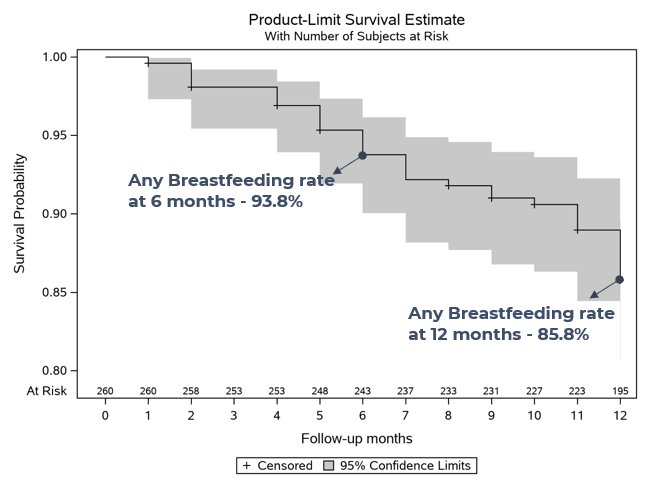
93.8% of participants were breastfeeding at 6 months and 85.8% at 12 months, exceeding US national benchmarks (~50–75%).
06
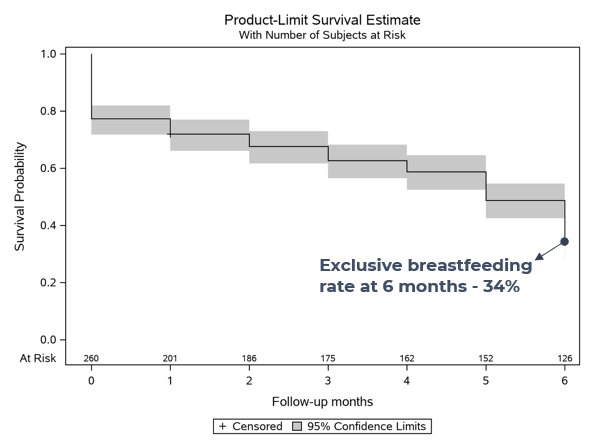
Exclusive breastfeeding at 6 months reached 34%, more than triple the previously reported US average of ~10%.
Real-time visualization of milk transfer extends the duration of both any and exclusive breastfeeding beyond national standards. By providing objective confirmation during the critical first month, this technology helps mothers build the confidence necessary to meet and exceed breastfeeding goals. Flow01 represents a substantial advancement in evidence-based lactation support.
Visual aid to help you explain essential breastfeeding concepts, including:
The infant breastfed immediately after birth. However, after three days, nipple wounds developed, leading the mother to begin pumping.
At the time of consultation, the mother was breastfeeding approximately three times a day (morning, noon, and evening), with all other feeds given via bottle due to significant pain. The pain occurred primarily toward the end of feedings. Despite seeing two prior lactation consultants, the mother had not experienced improvement.
Initial Observation: We began with direct breastfeeding. Post-feeding, the nipple appeared compressed.
Flow Nipple Shield (Size Large – 24 mm)
The baby latched immediately using a cross cradle hold.
With the Large size, the baby opened her mouth much wider, and the latch improved significantly. Milk transfer became optimal with continuous flow visible in the tube.
Maternal Feedback: The mother reported zero pain during the session.
The following day
The mother reported a highly positive experience the following day:
“Yesterday I breastfed once with the nipple, and the experience was really good. It didn’t hurt at all, and being able to see when and how much she was eating was really nice. It seems the nipple really helps her latch better… The position you taught me and the adjustments you gave me helped me so much! The pain has significantly decreased even when I’m not using the nipple. I didn’t believe breastfeeding could be painless.”
One-month later Follow-up
The mother now reports that her use of the Flow is minimal, as she has successfully transitioned to nearly exclusive breastfeeding. She has significantly reduced bottle use to only once during the day and once at night (and occasionally less).
The most significant result is the resolution of physical trauma; the mother reports she “almost no longer feels pain.” The Flow served its purpose as a temporary bridge, allowing the mother to correct her positioning and regain confidence. By providing a painless “reset” for her nipples, she was able to return to direct breastfeeding, achieving her goal of a nearly exclusive breastfeeding relationship.
Patient Quote
“I exceeded my breastfeeding goals and transitioned to almost exclusive breastfeeding. I truly never believed I could get to this point”